Reynosa, Tamaulipas Tamaulipas  Mathematical Olympiad in Tamaulipas (May 2006)
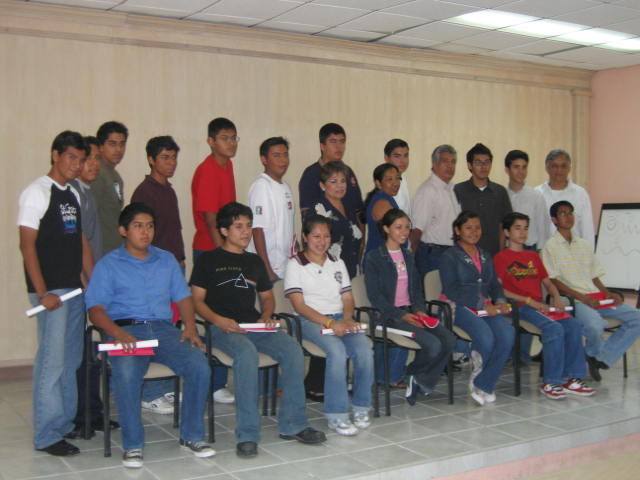
 The contest for the screening of Tamaulipas (toward the 2006 national competition of Mexican Mathematics Olympiad - WMO -) was held in the city of Reynosa on the 13th of May. As a result 15 teenagers were chosen, candidates to represent Tamaulipas in WMO in November this year.
And perhaps the woman in the street (gender pressures force me to write that) one might ask who do you think of mathematics competitions to enter? Is this masochism? Is it a boss? But if math is incomprehensible!
Well, what I can say is that the biases of the adolescent towards scientific disciplines are rare but they exist. A genetic predisposition towards mathematics mathematician and activate your module makes it a candidate to enter the mathematical community. It may be, however, that environmental pressures (eg, if home community boasts haberles never understood) what lead to other vocations and other communities. I just got their bread let them eat! Meanwhile, I argue that the mathematics competitions serve the function of an escape route to the disaster education, are doors that lead out of the ghetto education system.
The test consisted of three problems worth 7 points each, and took about 47 teens representing the three zones (north, central and southern) state of Tamaulipas. Each zone began in February the selection process, resulting in 15 or 16 selected in each.
Reynosa's contest is the third filter and process selection. And of the 15 shortlisted choose the highest performing 6 to represent in the national competition Tamaulipas. This will require training and screening tests, according to the program developed for this purpose by the delegation Tamaulipas WMO - represented by the Master of Urban Cepeda CEBTIS 7 of Reynosa. The road to the national competition is long and tortuous, but the effort will be rewarded with a medal, a mention ... and the opportunity to reach the IMO 2007, international competition for more traditional math and importance in the globe.
problems
1. A trader wants to know the weight (which known to be an integer) of the products it sells. For this, only with a pan balance and want to make a heavy one for each product. The problem is you only have n + 1 weights whose weight is a power of some basis (ie, the weights are weights a ^ 0, a ^ 1 ,..., a ^ n) and has a single weight each type. Are asked to determine all integer values \u200b\u200bof a (a> 1) for which you can do what the dealer wants.
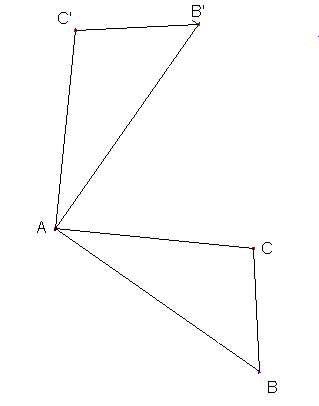
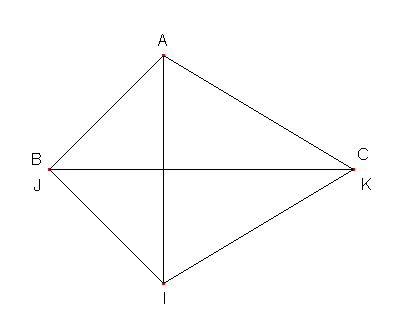
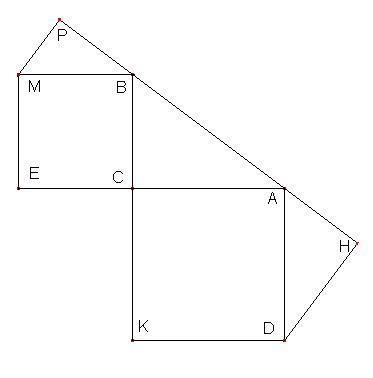
2. A circle passes through points A and B of triangle ABC is tangent to side BC at point B. AC side intersects the circle at M, so that AM = MC + BC. Find the value of BC if you know that AC = k.
3. On each side of a polygon with 2006 sides 2006 points placed arbitrarily. How many triangles can be formed using these points as vertices?
solutions
The geometry problem was solved by anyone. Perhaps to be highly dependent on the theorem called
power point - which is accompanied by many concepts of geometry of the circle. (Needless to say that school geometry never goes beyond the areas and volumes - neither good nor bad, it's just a fact of education.) This perhaps explain why some adolescents were unable to even figure - which was worth 1 point. Draw
the reader with the figure to facilitate understanding of the
Solution to Problem 2
The point C is outside the circle since it is tangent at B to side AC BC and the short M. There is then the equation (for power of a point to a circle): CB ^ 2 = CM (CA). With this equation and the condition AM = MC + CB (which becomes k = 2MC + CB) can achieve a quadratic equation whose solution is the solution of the problem.
Sea as x = BC. Then, x ^ 2 = CMK = k (k - x) / 2. Ie 2x ^ 2 + kx - k ^ 2 = 0. And this equation factors as (2x - k) (x + k) = 0. For Thus, the positive solution x = k / 2, which serves to be a distance x = BC. Breviary
cultural mathematical :
Most geometry problems can be solved by similarity, and this one is no exception, but the teenager who knew the theorems of geometry of the circle would facilitate the task of solving the problem without have to demonstrate at the time of the examination two or three theorems that lead to that used here. The moral problem solver performance for a teenager would be interested, would not (as many believe education experts) to go to the test "to see what I can" but to bring the inventory review "What should happen to me"
Solution to Problem 1
This solution is based on Rafael Navarro, a contestant who won a constructive solution - and diagrammatic.
First you see that for a = 4 is not possible to weigh certain weights, even putting weight on both sides of the balance. Let a = 4 and try to weigh a product w = 2 units of weight. The weights are 1, 4, 16, etc. The key to seeing that it is possible to notice the heavy is that no two weights b and c whose difference is 2 units, which improve the balance would be achieved by putting on one side w + by the other c (c - b = 2 .) The same counter-example sufficient to prove that it is not possible to weigh a product of weight w = 2 power of a> 4. (See this worth 3 points.)
With a = 2 can weigh all the products by placing weights on one side of the scale, it is known that any number can be expressed in binary numbering. Rafael exemplified with 108 (base 10) = 1101100 (base 2) = 64 + 32 + 8 + 4. (Rafael was able to activate their theoretical knowledge in long-term memory and transfer it to the specific problem situation before him. The question is not teaching how could he get it? But since you already have, how could be transferred to the situation ?)
With a = 3 we again invoke the known fact (at least for Rafael) that any number can be represented in the ternary system. Only in this case the ternary representation would not be acceptable to do some heavy products - unless they put weights on the two scales. Illustrate this case with the example provided by Rafael and the way in transforming the ternary into a heavy representation allowed.
first put the weight of the product in the ternary system: 83 (base 10) = 10002 (base 3) = 81 + 2 (1). We see that the ternary representation to correspond to the weight of 81 (power 4, 3) and two weights of 1 (zero power of 3). But we have two weights of the same power!
How this obstacle? Rafael's solution was: when a 2 in the ternary expression, immediately put the heaviest weight which appears twice and balance in the other pan. In the example would be: 83 + 1 = 10010.
Note that it is always possible because the difference between two consecutive powers of 3 can be expressed as twice the lowest power: 3 ^ n - 3 ^ (n-1) = 3 ^ (n-1) (3 - 1 ) = (2) 3 ^ (n-1). To achieve the transformation we interpret Rafael reverse, as the problem arises when a 2 in the ternary rerpesentación product weight. For example, if the product weighs w units and the balance is achieved with w = w_1 + (2) 3 ^ (n-1), then the balance is also achieved with w = w_1 + 3 ^ n - 3 ^ (n-1). Which, interpreted in the balance, equivalent aw + 3 ^ (n-1) = w_1 + 3 ^ n.
diagrammatic theoretical considerations on the problem 1 Here again, the question is not how did he know Rafael ternary numbering system? but how could make
link between representation and the specific situation and heavy weights? And the moral, in this case is that it proved that the transfer of knowledge from the abstract to the concrete is possible. The only problem is that experts still do not know how it is given (in terms of cognitive processes) such transfer. (Maybe we should be pleased to know that the transfer takes place - at least for some students ...)
As is known, the problems of heavy weights and
(
balance-scale task) have been widely used in cognitive psychology to shed light on ways of information processing in children (see, for example, this article
)
And this is possibly due to the scale is an intuitive and visual model for linear equations: each dish the scale represents one side of the equation and the balance of the dishes is his correspondence with an equal sign. Hence, many rules of arithmetic operation on the corresponding linear equations are in the balance. For example, adding (subtracting) a number on one side of the equation is equivalent to adding (removing) a heavy weight on the plate number corresponding to the side. It follows that the algebraic rule "do the same on both sides of the equation is obvious equivalent in the balance. With that background we come to the
Alternative solution to problem 1 For n = 0, we have only weighs a ^ 0 = 1 and clearly despite only be selling 1 unit of weight. If n = 1, already have the weights 1 and, and are possible heavy goods 1, a - 1, a, and + 1. The key to this workaround is that increasing n by one, they can weigh heavy all could be done with n - let's call the whole s_n - plus possible with the weight a ^ (n +1) added.
To further clarify the point (and using the diagrammatic idea already discussed between equation and balance) we agree to represent a balance equation, where the left is the dish where you put the product in spite (plus possibly some weights) and w call with product weight:
- w = 1, the product in the left plate and a weight of 1 unit in the right;
- w + 1 = a, the product and a weight 1 in the left, and a weight on the right;
- w = a, the product on the left and a weight on the right;
- w = a + 1, the product the left and two weights (1 already) on the right).
The rule for generating the heavy as possible, when we pass from n = 0 n = 1 (when we went from having a weight 1 to have the weights 1 and) is added to that could be done with n = 0 (s_0 = {1}), new heavy that can be done by adding the weight a. And these are the same, plus that can be achieved by adding or subtracting aa ^ January 1 s_0 heavy.
For the sake of argument, let's agree that in the equation representing the balance (and weighing), we w only on the left side and pass the rest to the right. The interpretation would be that the negative number on the right side are the weights that are placed on the left plate (with the product though.)
This heavy representation of an equation, in general, from nan + 1, the heavy potential are all of s_n, plus a ^ (n +1) itself, plus it is heavy adds or subtracts aa ^ (n +1) of the heavy s_n. In the example we carry, from n = 0 n = 1, n = 0 was heavy all s_0 = {1}. With the new weight a ^ 1, is added to it, plus you can do adding and subtracting aa ^ 1 one of the heavy s_0. It is then that S_1 = {1, - 1, a, a + 1}.
Note, before continuing, that a - 1 should not be greater than 2, because if a - 1 = 3 or greater then a product of weight w = 2 can not be weighed. So the only possible values \u200b\u200bfor a are 2 and 3. In the event that a = 2, there is a redundancy if we are even with weights on both plates: the heavy w = 1 can be done in two ways. If a = 3, S_1 = {1, 2, 3, 4} and the weighing procedure is not redundant - and more efficient in the number of weights required. (A classic problem objects weighing between 1 and 40 units of weight with 4 weights - that tells the reader how he would do and what weights.)
weighing method with a = 3 The heavy with a = 2, just use one of the plates to place the weights. Not so with the weighting method for a = 3, which will have to put weights on both plates. Let's see how you get the whole weighing S_2 possible with weights 1, 3, 9.
By adding weights weighs 9 to 1 and 3, we have the set of heavy S_1 = {1, 2, 3, 4} whose elements do not require weighs 9 for weighing. Clearly S_2 S_1 includes heavy. Let's see how to obtain the extra heavy 5, 6 ,..., 13:
- w = 5 = 9 - 4 = 9 - (3 + 1);
- w = 6 = 9 - 3;
- w = 7 = 9 - 2 = 9 - (3 - 1) = 9 - 3 + 1;
- w = 8 = 9 - 1;
- w = 9;
- w = 10 = 9 + 1;
- w = 11 = 9 + 2 = 9 + 3 - 1;
- w = 12 = 9 + 3;
- w = 13 = 9 + 4 = 9 + 3 + 1.
comment only two of the heavy, to remember the code above on the meaning of addition and subtraction: w = 7 is obtained by decomposing the 7 in addition and subtraction of powers of 3 (the rest are the weights that are put left on the plate with the product though), the equation w = 9 + 3 to 1 would mean that in the left plate is put the weight 1 with the product that weighs 11, and in the right place weights 9 and 3.
Note also that in the decomposition of a weight additions and subtractions of powers of 3, takes into account how heavy was achieved in the previous set. To illustrate let me explain how this is the heavy 40 once you enter the weight of 27 = 3 ^ 3: 40 = 27 + 13 (and 13 and know how to weigh it), so 40 = 27 + 9 + 3 + 1 .
Finally, add that if we denote the set of heavy s_n with weights 1, 3, 9 ,..., 3 ^ n, and the heavy S_i s_n i, then the elements of S_ (n +1 ) are the heavy plus heavy s_n 3 ^ (n +1), plus the heavy form 3 ^ (n +1) + w_i or 3 ^ (n +1) - w_i, where w_i is an element of s_n. That is, is a valid heavy weights 1, 3, 9 ,..., 3 ^ n.
Solution to Problem 3 Problem 3
is a pure combinatorial problem, only that the numbers are very large (which probably scared the contestants). If the statement had been "on each side of a pentagon are placed 5 points ..." most likely would have found it relatively easy.
To avoid being overwhelmed by numbers as large as 2006, Ivan Cesar Saldaña theoretically solved it first, but ultimately came into conflict with the theoretical spirit and gave as an answer (probably correct, but who would dare to check it?) the number 1648649335338799230.
Cesar theoretical solution is: Let m
total number of points in the polygon and k the number of sides. Then, C (m, 3) is the number of distinct triples of points. In this number, subtract the triads of points falling on one side (it does not form a triangle). The number of such triples is lined on one side of C (k, 3), but k sides such as the total number of triads are aligned kC (k, 3). For the same reason, m = k ^ 2. Therefore, the answer is T = C (k ^ 2, 3) - kC (k, 3).
Note: For reasons of space - And not frighten the readers - I miss Cesar calculations to achieve the above number, I'll just say that occupied 3 pages full of numbers.
To end these notes on the competition for Reynosa on May 12 reiterated the invitation to teens interested in math (and fans to the Internet) to join the group of friends Tamaulipas and school mathematics competition. Contributions, questions can coemntarios entering the
http://groups.msn.com/VLTamaulipas/ JMD in VL greets



 Elemental