Thursday, September 28, 2006

Stretching The Labia Before And After

northeastern Mexico Conjectures given geometric configuration Tamaulipas

The northeastern Mexico VI Mathematics Olympiad (NMO) in Victoria
- by José Muñoz Delgado -

Event and Context

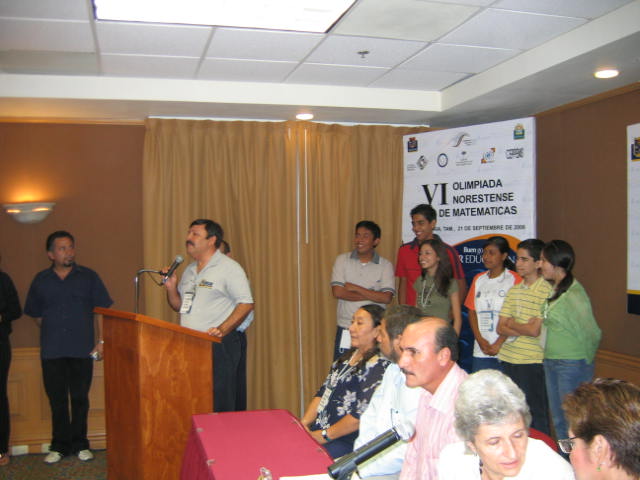
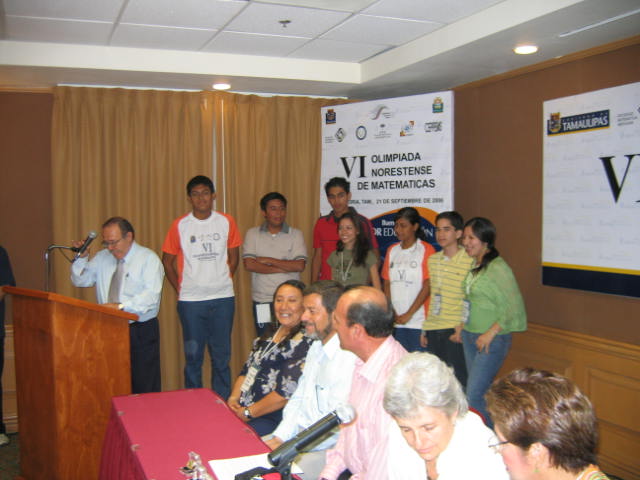
In an unprecedented symbolic act, the opening (Thursday, 21 September) ONM VI was the backdrop to announce the interest of the Ministry of Education of Tamaulipas (SET) and the Universidad Autonoma de Tamaulipas (UAT) in institutional strengthening school mathematics and its teaching in the state through the inter-agency project called "Learning Mathematics for Life."

The ONM is an event held every year as a contest prior to (and preparedness) the national competition for the Mexican Mathematics Olympiad (OMM). ONJ involved in Coahuila, Nuevo Leon and Tamaulipas, each with 15 teenagers shortlisted, and training for possible participation in the national contest of WMO.

The three delegations stayed at the Hotel Holiday Inn Express, the opening ceremony was held at the Centre of Excellence for the UAT, and the competition itself was on the premises of the UAM of Science, Education and Humanities (UAMCEH) for the TSU.

The Mathematics and Its Context Cares

For some reason (possibly sentimental) human beings are attracted to certain poles of attraction and communities formed around them (and, arguably, tribes). And following that human law (human too) a significant number
school mathematics teachers in Tamaulipas have gathered around the Math Olympiad devoting their time and effort to preparing teenagers for the competitions, no more pay than the mere satisfaction
see them rise in their level of knowledge and skills involved in math.

very particular in my case, I have dedicated much of my free time to the mathematics of competition since it started in Mexico, the organization of the Olympics Math (this year is 20, so take out the calculator ...) with some periods
forays into other fields (such as two and half years - 2003 to 2005 - I spent to get a master's degree in communication University of Guadalajara more expensive, thanks to PROMEP). But this year 2006 - and since late 2005 - I sold my watchtower math "with the slogan" The UAT should serve the state mathematically gifted adolescents. " Y. .. well ... against all odds ... a server and fellow teachers who joined my effort we convinced
UAT UAT and convinced the SET and the result is the interagency project launched at the opening of ONJ.
I think we're on the plastic moment in which the community of mathematicians Tamaulipas, related and supporters should join the project to flourish.


problems

contest the contest day I was walking in an effort to apply (to the Dra.Radmila Bulajich, president of the WMO Organizing Committee, who kindly accompanied us during the days of the event) transfer DEGETI Delegation to the UAT and therefore had not planned to be on the jury. But to get that day's contest UAMCEH facilities where the examination took place, the current company convinced me to be present at the jury, at least as an observer. Troubleshoot

decide the evaluation criteria for each test review, discuss the scores of cases unclear and / or controversial, casting hub scores, allocation of places (the medals) to competitors according to their performance, and report preparation. These are the tasks I was involved with the other jurors during the Friday, September 22 - from dawn to dusk and a little more.

For that the reader can form an idea of \u200b\u200bthe level of difficulty of the problems and the type of problems that the contestants have to solve, then the transcribed (the wording is not mine) and comment. Also transcribe the official solution, and drafted an alternative solution in the style of reasoning can of adolescents to address these difficult problems.

Problem 1. Show that there are infinite "m" such that n ^ 4 + m is a composite number for all n positive integer.

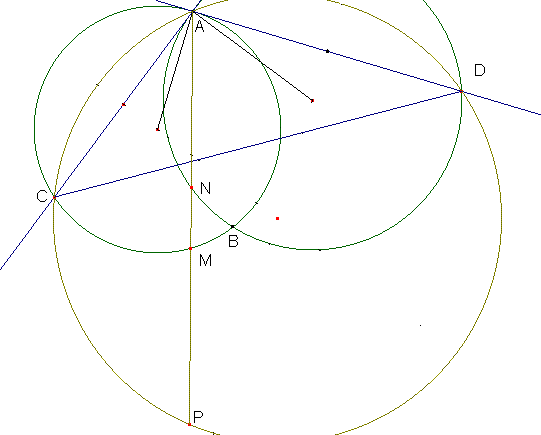
Problem 2. C1 and c2 are two circles that intersect at two points A and B. The tangent at A intersects c2 for c1 in C and the tangent to c1 and c2 A intersects D. A ray passing through A, inside the angle CAD, in M \u200b\u200bintersects c1 to c2 in N and the triangle ACD circuncírculo P. Prove that AM = NP.

Problem 3. It has a circumference perimeter 210. We have marked in the same 20 points, P1, P2, ..., P20, following the direction of clockwise so that the arc joining the point P1 to P2 has length 1, the arc connecting the point P2 P3 has the length 2, ... and so on, the arc joining the point P20 to P1 has length 20. Find all pairs of points scored such that the segment that joins them is the diameter of the circle.

General Comments on the Problems

The easy problem is 3. And this in the sense of being more visual and approachable by brute force - enough to know the meaning of "diameter." However, I should say that the problem 1 is easier that 3, but in another sense: the contestant must be convinced that intimidating statements on issues of competition tend to be easily "broken" translating into a language less esoteric.

In Problem 1, this translation could be "express m in terms of an integer r, such that n ^ 4 + f (r) is factorizable for any positive integer r." This translation has been to seek to complete the perfect square trinomial, difference of squares require and obtain the m requested. - The method could be called "backward inference" and illustrated in the alternative solution of this problem shown below.

Problem 1, however, Easy IMO the 1969 and would show that the judges considered it IMO international level. (See www.kalva.demon.co.uk/imo/ )

The really difficult problem is 2, a circle geometry problem. It is difficult in two respects. First you have to do (or generate - see alternative below) the binding idea and use it to build the solution, which requires familiarity with instances of use of the geometry of the circle - in particular, angles enrolled and semi-attached - to establish the similarities between pairs of triangles in the configuration. And this is assuming that the competitor and dominates geometric terminology (tangent, circuncírculo, etc.).

A lesson could be learned from the problems 1 (of the IMO 1969) and 2 - and usable for teens interested in math competition - is "if you can solve at home is better." At home, ie during pre-contest preparation.

Official Solutions

As in the textbooks that the solution of a problem is too compressed to see the official solution to the problems of a mathematics olympiad examination is often frustrating for the adolescent and their coaches, because it very often, enigmatic -To say the least. Is no exception for solutions to problems brought NOM jurors prepared.

then present them and remind readers that, in both math textbooks and in the issues of competition, you always need an intellectual
additional work to fully understand the solutions.

Solution to Problem 1.

n ^ 4 + 4r ^ 4 = (n ^ 2 + 2RN + 2r ^ 2) (n ^ 2 - 2RN + 2r ^ 2). Clearly the first factor is greater than 1, the second factor is also greater than 1 for r greater than 1. So we can take m = 4r ^ 2.

Solution to Problem 2.

Consider without loss of generality that the ray is inside the angle BAC. Then angMCA + angCAM angCMP = = = angCAD angMAD + angCAM. Moreover, angCPM = angCAD by subtend the same arc. Then, as the triangles ACD and MCP are similar, we have MC / AC = MP / AD. In addition, angACM = angNAD and angCAM = angADN. Therefore, the ACM and DAN triangles are similar. So AN / AD = MC / AC, and hence MP = AN and AM = NP as intended.


Solution to Problem 3.

couples looking all points (Pj, Pk), with 0 less than k jmenor below 21, that meet the segment that joins them is diameter. O equivalently, the length of the arc that joins them is 105. But as the length of the arc that goes from Pj to Pk is

j + (j +1) +...+ (k-1) = (k-1) k / 2 - (j-1) j / 2 ,

we should look for partners who meet k-1) k / 2 - (j-1) j / 2 = 105.

As (k-1) k / 2 - 105 should be positive integer or zero, and k = 15 is zero, then (P1, P15) is one of the couples wanted. The rest are giving ak value greater than 15 and verify if the result can be achieved with some j (j-1) j / 2. The partners sought are (P1, P15), (P6, P16) and (P12, P19).

Alternative Solutions and / or Constructive Feedback

constructive solution to problem 1

Note first that you want to factor n ^ 4 + m. That is, we n ^ 4 + m = (?)(?). The easiest thing is to complete the perfect square trinomial, and in the process, trying to guess how m. First, notice that we should make m = a ^ 2. So we have to do is complete the square in n ^ 4 + a ^ 2. Let's see:

n ^ 4 + a ^ 2 = n ^ 4 + 2 (n ^ 2) a + a ^ 2 - 2 (n ^ 2) a = (n ^ 2 + a) ^ 2 - 2 (n ^ 2) a.

However, for this expression is factorable, it is easiest to see as the difference of squares. Thus, a simple 2 (n ^ 2) a = r ^ 2.

But ... No. No. Here I have one 2 ... So I can improve my building by 2 (n ^ 2) a = (2r) ^ 2. But ... No. No. Not that either. The n ^ 2's I can leave out because it is a square. So it is better to 2a = (2r) ^ 2. Therefore, 2a = 4r ^ 2 or ^ 2 = 2r. So a ^ 2 = 4r ^ 4.

(Note that taking an initial idea as a perfect square m in general, it was a perfect square shape generated more specific the obligations of the solution is sought.)

After phase search and exploration of earlier (the discovery phase) and can be passed to the justification phase in the solution shown official. It would, leaving few traces of the search phase, something like


n ^ 4 + 4r ^ 4 = (n ^ 2) ^ 2 + (2r ^ 2) ^ 2 + 4n ^ 2 (r ^ 2 ) - 4n ^ 2 (r ^ 2) = (n ^ 2 + 2r ^ 2) ^ 2 - (2NR) ^ 2.

reader is left to the pleasure of completing the argument.

constructive solution to problem 2

The search for a solution to problem 2 below shows that is instructive of how to proceed in troubleshooting contest proves to be very effective in breaking the enigma that is the question. The statement is: Sean


c1 and c2 two circles intersecting at two points A and B. The tangent to by A intersects c2 c1 in C and the tangent to c1 and c2 A intersects D. A ray passing through A, inside the angle CAD, in M \u200b\u200bintersects c1 to c2 in N and the triangle ACD circuncírculo P. Prove that AM = NP.


part of the request. Ask you to show AM = NP. After a mental search for possible general strategies, one can conclude that similar triangles should be used. The strategy of similarity is almost infallible in such cases where there is a geometric configuration with overlapping circles. So like ... But what triangles ... Many! What we will do next is to find the right triangles, ie, pairs of similar triangles that would lead to the solution.

first thing you have to do is a good figure. The visual aid is valuable. Secondly we explore the possibilities of triangles to each side of the equation:

AM AMC's side of the triangle (note that triangle is the only configuration that AM is right). Now we focus on AMC triangle sides looking to link with others in the configuration: MC side of the triangle is MCP, and AC is the side of the triangle ACD (and ACP).

Now see the other side of the equation AM = NP. Note that here, as before, there is only one possibility - which makes us task. Now, as before, we focus on NPD to find the triangle linking with other triangles sides of the setup: DN DNA side of the triangle, and PD is next to the PDC.

To facilitate finding the appropriate pairs of triangles we form a crosstab: Side Triangle


AM AMC


AC MC MCP
ACD

NP NPD
DN DNA


PD PDC

This table and the figure should reach (after a while of searching) a pair of triangles ACD, NPD and AMC, PDC. For the purpose of developing a guess that we should look similar enough in Fig. Because there are other similarities that might link the two sides of the equality we want to reach, it is worthwhile to explore whether pairs and found lead us to something solid.

If NPD were similar to MCP, we would have NP / MC = PD / CP (note that we seek to NP and MC are present in the ratio). And if AMC would like DPC, would have AM / DP = MC / PC (note that we now seek to flirt as much as possible with the above.)

So, if you give these similarities, we would have NP / MC = PD / CP = AM / MC and arrive at NP = AM, as intended. So now we have to do is demonstrate that these similarities actually exist and we will finish. Left the reader the task. Only give the key suggestion to observe that the tangents from A to their respective circles are the key to see the similarities of angles required to establish the similarities.

Alternative method for guessing the similarities appropriate for problem 2

new parties of the request to show AM = NP, but now we will be forming ratios and proportions that do not affect equality, but at the same time be ligand triangles in the configuration:

AM = NP

AM / MC = NP / MC (the first reason and is, necessary to resolve the second)

AM / MC = NP / MC = (NP / PA) / (MC / CP) (the denominator and is, missing numerous)

(NP / CP) = (NP / PS) / (CP / PD) (and you are also numerous)

In summary, we have AM = NP is equivalent, in an algebraic sense, the AM / MC = [(NP / PS) / (CP / PD)] / (MC / CP) . And now look, visually aided by the figure, which corresponds to right reason on the left, again in a visual relationship of similarity. It is easy to see that AMC is like DPC and what remains is (NP / PS) / (MC / CP), which must be unity, ie, should be met similarity between triangles NPD and MCP. EUREKA!

Note: Again we reach the same conjecture, and, again, need to prove that the similarities do exist. There must also say that both procedures are heuristic, in the sense that it ensures that reaches a solid guess. And
also be emphasized that similarities in this search could continue to dead ends, before this thing to do is retrace the steps already taken and find another route. Conclusion


We wanted here to account for the Northeast VI Olympiad held in Cd Victoria Tamaulipas facilities UAMCEH-UAT on Friday September 22, 2006. The event was the importance added it was a symbolic act that inaugurated an era of government support for school mathematics in Tamaulipas. Additionally, it has been a pleasure to comment on the problems and their solutions, as well as a method of guessing similarities in geometry problems and useful for competition issues, allowing parties to focus gerométrica settings appropriate for the solution of the problem and avoid the teen "throw in the towel prematurely before the chaos of lines and points he has before his eyes could not decide on a promising path to solution.

Tuesday, September 26, 2006

Jolteon Stuffed Animal

Selection for OMM 2006

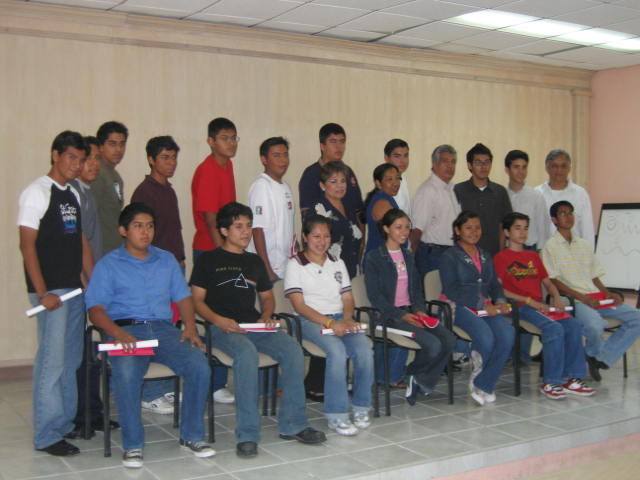
In the bottom photo shows members of the selection to represent Tamaulipas in the national competition for the Mexican Mathematics Olympiad. The last review was selective northeastern Mexico Math Olympiad in which participated the presets of Coahuila, Nuevo Leon and Tamaulipas. The photos are from the closure on Saturday 23, the day after the test.


Thomas appears in the second picture as the seventh member, even if they compete at the national level. But he won the trip for winning silver in the ONM. The gift is what makes the state government as a reward for their effort. Good detail of the authorities, because Thomas is a promise, you still have two chances to go national - is first semester of high school. Radmila Bulajich accompanied us during the days of the event, thanks be given him.


These days I post the details of the contest northeastern Mexico, especially the problems and their solutions. Sincerely


jmd in VL

Sunday, May 21, 2006

Lubercant For Masterbation

Reynosa, Tamaulipas Tamaulipas


Mathematical Olympiad in Tamaulipas (May 2006)

The contest for the screening of Tamaulipas (toward the 2006 national competition of Mexican Mathematics Olympiad - WMO -) was held in the city of Reynosa on the 13th of May. As a result 15 teenagers were chosen, candidates to represent Tamaulipas in WMO in November this year.

And perhaps the woman in the street (gender pressures force me to write that) one might ask who do you think of mathematics competitions to enter? Is this masochism? Is it a boss? But if math is incomprehensible!

Well, what I can say is that the biases of the adolescent towards scientific disciplines are rare but they exist. A genetic predisposition towards mathematics mathematician and activate your module makes it a candidate to enter the mathematical community. It may be, however, that environmental pressures (eg, if home community boasts haberles never understood) what lead to other vocations and other communities. I just got their bread let them eat! Meanwhile, I argue that the mathematics competitions serve the function of an escape route to the disaster education, are doors that lead out of the ghetto education system.

The test consisted of three problems worth 7 points each, and took about 47 teens representing the three zones (north, central and southern) state of Tamaulipas. Each zone began in February the selection process, resulting in 15 or 16 selected in each.

Reynosa's contest is the third filter and process selection. And of the 15 shortlisted choose the highest performing 6 to represent in the national competition Tamaulipas. This will require training and screening tests, according to the program developed for this purpose by the delegation Tamaulipas WMO - represented by the Master of Urban Cepeda CEBTIS 7 of Reynosa. The road to the national competition is long and tortuous, but the effort will be rewarded with a medal, a mention ... and the opportunity to reach the IMO 2007, international competition for more traditional math and importance in the globe.

problems

1. A trader wants to know the weight (which known to be an integer) of the products it sells. For this, only with a pan balance and want to make a heavy one for each product. The problem is you only have n + 1 weights whose weight is a power of some basis (ie, the weights are weights a ^ 0, a ^ 1 ,..., a ^ n) and has a single weight each type. Are asked to determine all integer values \u200b\u200bof a (a> 1) for which you can do what the dealer wants.

2. A circle passes through points A and B of triangle ABC is tangent to side BC at point B. AC side intersects the circle at M, so that AM = MC + BC. Find the value of BC if you know that AC = k.

3. On each side of a polygon with 2006 sides 2006 points placed arbitrarily. How many triangles can be formed using these points as vertices?

solutions

The geometry problem was solved by anyone. Perhaps to be highly dependent on the theorem called power point - which is accompanied by many concepts of geometry of the circle. (Needless to say that school geometry never goes beyond the areas and volumes - neither good nor bad, it's just a fact of education.) This perhaps explain why some adolescents were unable to even figure - which was worth 1 point. Draw

the reader with the figure to facilitate understanding of the

Solution to Problem 2

The point C is outside the circle since it is tangent at B to side AC BC and the short M. There is then the equation (for power of a point to a circle): CB ^ 2 = CM (CA). With this equation and the condition AM = MC + CB (which becomes k = 2MC + CB) can achieve a quadratic equation whose solution is the solution of the problem.

Sea as x = BC. Then, x ^ 2 = CMK = k (k - x) / 2. Ie 2x ^ 2 + kx - k ^ 2 = 0. And this equation factors as (2x - k) (x + k) = 0. For Thus, the positive solution x = k / 2, which serves to be a distance x = BC. Breviary

cultural mathematical :

Most geometry problems can be solved by similarity, and this one is no exception, but the teenager who knew the theorems of geometry of the circle would facilitate the task of solving the problem without have to demonstrate at the time of the examination two or three theorems that lead to that used here. The moral problem solver performance for a teenager would be interested, would not (as many believe education experts) to go to the test "to see what I can" but to bring the inventory review "What should happen to me"

Solution to Problem 1

This solution is based on Rafael Navarro, a contestant who won a constructive solution - and diagrammatic.

First you see that for a = 4 is not possible to weigh certain weights, even putting weight on both sides of the balance. Let a = 4 and try to weigh a product w = 2 units of weight. The weights are 1, 4, 16, etc. The key to seeing that it is possible to notice the heavy is that no two weights b and c whose difference is 2 units, which improve the balance would be achieved by putting on one side w + by the other c (c - b = 2 .) The same counter-example sufficient to prove that it is not possible to weigh a product of weight w = 2 power of a> 4. (See this worth 3 points.)

With a = 2 can weigh all the products by placing weights on one side of the scale, it is known that any number can be expressed in binary numbering. Rafael exemplified with 108 (base 10) = 1101100 (base 2) = 64 + 32 + 8 + 4. (Rafael was able to activate their theoretical knowledge in long-term memory and transfer it to the specific problem situation before him. The question is not teaching how could he get it? But since you already have, how could be transferred to the situation ?)

With a = 3 we again invoke the known fact (at least for Rafael) that any number can be represented in the ternary system. Only in this case the ternary representation would not be acceptable to do some heavy products - unless they put weights on the two scales. Illustrate this case with the example provided by Rafael and the way in transforming the ternary into a heavy representation allowed.

first put the weight of the product in the ternary system: 83 (base 10) = 10002 (base 3) = 81 + 2 (1). We see that the ternary representation to correspond to the weight of 81 (power 4, 3) and two weights of 1 (zero power of 3). But we have two weights of the same power!

How this obstacle? Rafael's solution was: when a 2 in the ternary expression, immediately put the heaviest weight which appears twice and balance in the other pan. In the example would be: 83 + 1 = 10010.
Note that it is always possible because the difference between two consecutive powers of 3 can be expressed as twice the lowest power: 3 ^ n - 3 ^ (n-1) = 3 ^ (n-1) (3 - 1 ) = (2) 3 ^ (n-1). To achieve the transformation we interpret Rafael reverse, as the problem arises when a 2 in the ternary rerpesentación product weight. For example, if the product weighs w units and the balance is achieved with w = w_1 + (2) 3 ^ (n-1), then the balance is also achieved with w = w_1 + 3 ^ n - 3 ^ (n-1). Which, interpreted in the balance, equivalent aw + 3 ^ (n-1) = w_1 + 3 ^ n.

diagrammatic theoretical considerations on the problem 1

Here again, the question is not how did he know Rafael ternary numbering system? but how could make link between representation and the specific situation and heavy weights? And the moral, in this case is that it proved that the transfer of knowledge from the abstract to the concrete is possible. The only problem is that experts still do not know how it is given (in terms of cognitive processes) such transfer. (Maybe we should be pleased to know that the transfer takes place - at least for some students ...)

As is known, the problems of heavy weights and ( balance-scale task) have been widely used in cognitive psychology to shed light on ways of information processing in children (see, for example, this article )
And this is possibly due to the scale is an intuitive and visual model for linear equations: each dish the scale represents one side of the equation and the balance of the dishes is his correspondence with an equal sign. Hence, many rules of arithmetic operation on the corresponding linear equations are in the balance. For example, adding (subtracting) a number on one side of the equation is equivalent to adding (removing) a heavy weight on the plate number corresponding to the side. It follows that the algebraic rule "do the same on both sides of the equation is obvious equivalent in the balance. With that background we come to the

Alternative solution to problem 1

For n = 0, we have only weighs a ^ 0 = 1 and clearly despite only be selling 1 unit of weight. If n = 1, already have the weights 1 and, and are possible heavy goods 1, a - 1, a, and + 1. The key to this workaround is that increasing n by one, they can weigh heavy all could be done with n - let's call the whole s_n - plus possible with the weight a ^ (n +1) added.

To further clarify the point (and using the diagrammatic idea already discussed between equation and balance) we agree to represent a balance equation, where the left is the dish where you put the product in spite (plus possibly some weights) and w call with product weight:

- w = 1, the product in the left plate and a weight of 1 unit in the right;

- w + 1 = a, the product and a weight 1 in the left, and a weight on the right;

- w = a, the product on the left and a weight on the right;

- w = a + 1, the product the left and two weights (1 already) on the right).

The rule for generating the heavy as possible, when we pass from n = 0 n = 1 (when we went from having a weight 1 to have the weights 1 and) is added to that could be done with n = 0 (s_0 = {1}), new heavy that can be done by adding the weight a. And these are the same, plus that can be achieved by adding or subtracting aa ^ January 1 s_0 heavy.

For the sake of argument, let's agree that in the equation representing the balance (and weighing), we w only on the left side and pass the rest to the right. The interpretation would be that the negative number on the right side are the weights that are placed on the left plate (with the product though.)

This heavy representation of an equation, in general, from nan + 1, the heavy potential are all of s_n, plus a ^ (n +1) itself, plus it is heavy adds or subtracts aa ^ (n +1) of the heavy s_n. In the example we carry, from n = 0 n = 1, n = 0 was heavy all s_0 = {1}. With the new weight a ^ 1, is added to it, plus you can do adding and subtracting aa ^ 1 one of the heavy s_0. It is then that S_1 = {1, - 1, a, a + 1}.

Note, before continuing, that a - 1 should not be greater than 2, because if a - 1 = 3 or greater then a product of weight w = 2 can not be weighed. So the only possible values \u200b\u200bfor a are 2 and 3. In the event that a = 2, there is a redundancy if we are even with weights on both plates: the heavy w = 1 can be done in two ways. If a = 3, S_1 = {1, 2, 3, 4} and the weighing procedure is not redundant - and more efficient in the number of weights required. (A classic problem objects weighing between 1 and 40 units of weight with 4 weights - that tells the reader how he would do and what weights.)

weighing method with a = 3

The heavy with a = 2, just use one of the plates to place the weights. Not so with the weighting method for a = 3, which will have to put weights on both plates. Let's see how you get the whole weighing S_2 possible with weights 1, 3, 9.

By adding weights weighs 9 to 1 and 3, we have the set of heavy S_1 = {1, 2, 3, 4} whose elements do not require weighs 9 for weighing. Clearly S_2 S_1 includes heavy. Let's see how to obtain the extra heavy 5, 6 ,..., 13:

- w = 5 = 9 - 4 = 9 - (3 + 1);
- w = 6 = 9 - 3;

- w = 7 = 9 - 2 = 9 - (3 - 1) = 9 - 3 + 1;

- w = 8 = 9 - 1;

- w = 9;

- w = 10 = 9 + 1;

- w = 11 = 9 + 2 = 9 + 3 - 1;

- w = 12 = 9 + 3;

- w = 13 = 9 + 4 = 9 + 3 + 1.

comment only two of the heavy, to remember the code above on the meaning of addition and subtraction: w = 7 is obtained by decomposing the 7 in addition and subtraction of powers of 3 (the rest are the weights that are put left on the plate with the product though), the equation w = 9 + 3 to 1 would mean that in the left plate is put the weight 1 with the product that weighs 11, and in the right place weights 9 and 3.

Note also that in the decomposition of a weight additions and subtractions of powers of 3, takes into account how heavy was achieved in the previous set. To illustrate let me explain how this is the heavy 40 once you enter the weight of 27 = 3 ^ 3: 40 = 27 + 13 (and 13 and know how to weigh it), so 40 = 27 + 9 + 3 + 1 .

Finally, add that if we denote the set of heavy s_n with weights 1, 3, 9 ,..., 3 ^ n, and the heavy S_i s_n i, then the elements of S_ (n +1 ) are the heavy plus heavy s_n 3 ^ (n +1), plus the heavy form 3 ^ (n +1) + w_i or 3 ^ (n +1) - w_i, where w_i is an element of s_n. That is, is a valid heavy weights 1, 3, 9 ,..., 3 ^ n.

Solution to Problem 3 Problem 3

is a pure combinatorial problem, only that the numbers are very large (which probably scared the contestants). If the statement had been "on each side of a pentagon are placed 5 points ..." most likely would have found it relatively easy.

To avoid being overwhelmed by numbers as large as 2006, Ivan Cesar Saldaña theoretically solved it first, but ultimately came into conflict with the theoretical spirit and gave as an answer (probably correct, but who would dare to check it?) the number 1648649335338799230.

Cesar theoretical solution is: Let m

total number of points in the polygon and k the number of sides. Then, C (m, 3) is the number of distinct triples of points. In this number, subtract the triads of points falling on one side (it does not form a triangle). The number of such triples is lined on one side of C (k, 3), but k sides such as the total number of triads are aligned kC (k, 3). For the same reason, m = k ^ 2. Therefore, the answer is T = C (k ^ 2, 3) - kC (k, 3).

Note: For reasons of space - And not frighten the readers - I miss Cesar calculations to achieve the above number, I'll just say that occupied 3 pages full of numbers.

To end these notes on the competition for Reynosa on May 12 reiterated the invitation to teens interested in math (and fans to the Internet) to join the group of friends Tamaulipas and school mathematics competition. Contributions, questions can coemntarios entering the

http://groups.msn.com/VLTamaulipas/

JMD in VL greets

Tuesday, March 21, 2006

British Red Poppy Pin Mean

, Zona Centro, Congruence of Triangles


Problem 1 - the Regional Centre Zone Tamaulipas-


jmd 03/21/2006


Pre-selective examination on Saturday, 18 March at the CBTIS 236 has some lessons for the 16 shortlisted candidates to integrate the selection state of the Mexican Mathematics Olympiad. Above all, training suggestions. Then I will comment on the suggestions of training that we left the problem of geometry.


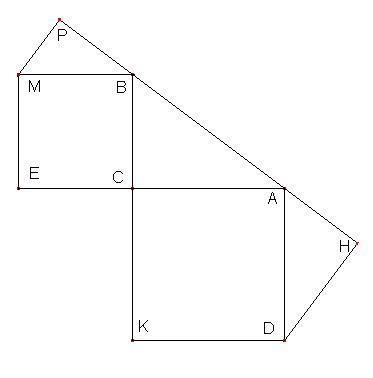
The problem in the legs AC and BC of triangle ABC have been built (outside the triangle) and BMEC ADKC squares. Points D and M are lowered perpendicular DH and MP on (sic) the continuation of the hypotenuse AB. Show that AB = DH + MP.

Elemental

but not both. How to link MP and DH with AB? The problem certainly requires scouting.

The first association is Pythagoras, but after a little pondering is that PB and HA could not be removed from the resulting chain of equalities. In any case, not only Pythagoras.

similarity is another possibility. To the trained eye it is easy to see (or at least suspect) that the three triangles are similar.

Solution:

Denoting a, b, c to the sides opposite the vertices A, B, C, respectively, we can use the previous plan to use Pythagoras (A ^ 2 + b ^ 2 = c ^ 2) and replace b by similar triangles. Clearly the triangles

BMP and DHA are both similar to ABC (the angles CAB and MBP are the same as being relevant, and the same is true of CBA and HAD). Hence

DH / b = b / c MP / a = a / c. That is, a ^ 2 = b ^ 2 = CMP HRC, and substituting in Pythagoras gives the result: c (MP + DH) = c ^ 2 and you're done.

Comments to the solution (from the perspective of the learner)

This problem no contestant solved it. But why is it so difficult? Try seeing it for the parties to respond.

1. Before you even have a chance to resolve the learner should be able to figure (not included in the review). Most of the contestants drawn, so the difficulty is not there. It should, however, included in the training exercises nontrivial geometric trace. (For example, draw a triangle with a ruler and compass given an angle, the opposite side and adjacent one side.)

2. The evocation of Pythagoras is not problem-in fact the first thing that occurred to the majority.

3. The difficulty seems to lie in the recognition of similarity of triangles and the development of the settlement plan that combines Pythagoras and likeness. This points to an intensive training in similar triangles with many exercises, but also training in strategies for solving geometric problems in a "reading between the lines" of data and the figure, an interpretation that allowed the development of a settlement plan.

4. Note on training perspective of the writer:

1) Training is training, and therefore to adopt a position of letting the learner alone with their own creativity is to adopt a populist perspective (but also a contradiction. .. that is the point of training?)

2) Unfortunately, this perspective is present even among mere leaders of the WMO-an example: Illanes said in his book Problems of Olympiad included in the 2 nd edition a new chapter of induction "almost against my will as I have always thought that what should be assessed ... is the ability of students to solve problems and ingenuity put into solving them "-

3) The theoretical results are always useful as equip the learner with a tool box ready to use when drawing up the plan solution, and do not take away creativity and ingenuity but rather the stronger. Workaround


This solution is subtle, it requires training to see the movement of figures through the eyes of the mind.

A dynamic geometry training (with CABRI, for example), would provide the apprentice with a wider menu of creative ideas when preparing a solution plan. Might guess, for example, that the triangles at the ends may be rotated and ...

BMO Turning the triangle on the center B, 90 degrees is obtained BCP triangle. " Turning -90 DHA on A gives the ACH. "


And the settlement plan is almost ... (You're seeing the result, still need to prove it.)


If we call C 'at the foot of the perpendicular to AB lowered from C, the plan would be to demonstrate congruence between pairs of triangles BMP and CBC', ADH and CAC. "

cognitive power acquired by the apprentice training in geometric transformations is enormous. And this is particularly true in the development of the settlement plan. (Note, incidentally, to begin an official solution "is C 'the foot of the perpendicular ..." In other words, lies precisely what the learner needs the most: the methods of reasoning that lead to the development of the settlement plan.)

JMD in VL
greets