Thursday, August 25, 2005

Can I Share Clothes If I Have Herpes

Monty Hall Paradox


make a deal (The Monty Hall Paradox)

Suppose that in a TV show you are participating and animator gives choice of three doors: what's behind the chosen is yours. Behind one of them is a new car, behind the other two a goat. You choose one of doors, say 1, and at that time (before opening) the driver, who knows what's behind each door, opens one of the other two, say 3, and shows a goat. And I asked "do you want to change your choice (opening the door 2)?" Do you should change?

This problem is paradoxical because common sense tells us that since we know nothing about what's behind the other two doors are the same chances of winning with which they choose with the other. But it can be shown that since the driver does know that behind the doors, it should change our decision. For a discussion of this point see http://math.ucsd.edu/ ~ crypto / Monty / montybg.html .

What implications does the driver know what's behind the doors? The most important is that the two two-thirds of the time (with probability 2 / 3) has no choice: the door that opens is the prize! Why, with probability 2 / 3? Well, eventually, for example of 100 players, about 67% of players choose a losing door (behind it is a goat) and in those cases the driver will have to show the contestant losing the second door (can not show the car). That is why the participants have more chances to win by changing your election to the third option as a strategy (ie, always, as a rule). Of course, if I had chosen the car door is going to lose, but that will happen with probability 1 / 3.

Wednesday, August 3, 2005

The Bottom Less Part In Harold And Kumar


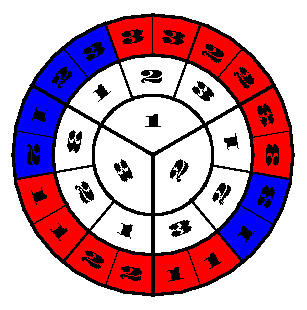
This configuration of shapes and colors for the previous post. I decided to add it to the posts that try to be hoaxes. Moreover, it is a test to put pictures on the blog and try to make it more friendly (in the sense of friendly software). In the case of a post with a problem and see which configuration you get. Sincerely jmd

in vl

Can You Do Mma With Genital Warts

Guide Hatter happy (and yet, tragic) Troubleshooting

Note: it is understood that the guide is in the air (not that, but present) to solve mathematical problems in contemporary education - no one should be attributed (in particular swear the author was not me!)

Rule 1: Whenever possible, avoid reading the problem statement. Reading takes time and causes confusion. (Especially when it includes words not commonly used in youth culture - which is almost always ... ... what little kindness.)

Rule 2: Extract the numbers stated in the order they appear. Be careful with the numbers written in words.
Rule 3: If rule 2 gives you three or more numbers, the best chance is to add them all.
Rule 4: If two about the same size, then the rest is a good bet to achieve a good result.
Rule 5: If two numbers but of very different sizes, then divided, but if the division is more accurate then multiplies.
Rule 6: If you beat the problem requires using a formula then choose one with enough literals (letters) to use all the numbers given in the problem.
Rule 7: If rules 1 to 6 seem not work, make a desperate attempt: take the set of numbers found in regulation 2 random filling operations run about two pages. Note: do not forget to enclose a circle or box with five or 6 answers in each page ... chance and one of them is the answer, remember that you can get some points for trying, and are such attempts.

final note: the method is particularly effective when the teacher is among those who like to put "real" problems (the classic example - called "the age of the captain" -: on a boat there are 25 goats, 10 and two bastards kids, how old is the captain?). Under Rule 3, the answer is 37 - and a captain of 37 years is typical, as can be seen in old pirate movies. (I think it is best to avoid giving this answer explanations when answering "undecidable response given the irrelevance of the data.")

Sunday, July 10, 2005

Best Bra At Victoria's Secret For Small Boobs

Review (Screener)

Problem:
Shows that 121 does not divide f (n) = n ^ 2 + 3n +5 for any natural number n.


Review:
Title: R_121_Criba In the petition "shows that 121 does not divide n ^ 2 + 3n + 5 for any natural n" the first thing that strikes our mind is the negative of the proposition (not divided) . How can I handle this? Ie how do you handle a negative proposition? If you ask "Prove that 121 divides a. .." like that somehow feels more manageable problem. But as it is posed the problem seems to us not computable, not processed by our cognitive systems. But it is. The force method Gross is daunting test for 1, 2, 3, ... A never ending story. "Induction? But if it is a denial? And our mind begins to spin in a whirlwind. But cool! If proposed in a contest should be resolvable. Moreover, it should be easy. First you have to look for clues of where you can enter. For any problem of competition must have a point of attack, a point where we can start thinking about your solution. The first clue lies in understanding what is asked. To avoid negative reading Let's think like I ask you to show that something is impossible (the 121 divide f (n)). If you know how to handle cases congruences reduce to 120 and you can apply brute force. And if well-organized calculations can verify the 120 cases in half an hour. But there's another track: 121 = 11 ^ 2. Why is it a clue? Well, because 11 is prime, and to verify that it is impossible that 121 divides f (n) is enough to prove that 11 does not divide twice to no n. The proposition calls for show can be translated as follows: two times 11 does not divide f (n). And here is now the key to the show: to divide into cases. (The 11 does not divide f (n), and if once divided not divide a second time.) Is the happy idea. The screening method. Another way to translate the problem and leads to the screen is to show that C = {n / 121 divides f (n)} is an empty set. The idea of \u200b\u200bscreening is to reduce on the search space. In principle, all cases must be analyzed. But with the screen first searched the n for which 11 divides f (n). This reduces the search space. Then in the set B = {n / 11 divided af}, we verify if 121 divides f for some element of B. First screen (method to determine if 11 divides f (n) for some n) as f (n) = n ^ 2 + 3n + 5 is not factorizable, it is factored leaving a multiple of 11 independent term. This requires adding and subtracting a constant c such that c + 5 is a multiple of 11 but at the same time, certain factors-c, say, c = ab, would have added the coefficient n in the equation, a + b = 3. (These formulas Vieta, a factorization method is applied intuitively and by trial and error: with practice the method considerably easier.) For this case we have (after several attempts): n ^ 2 + 3n +5 +28 - 28. The transformation sought, since n ^ 2 +3 n - 28 +33 meets the requirements and results in the factorization f (n) = (n + 7) (n - 4) + 33. And you can see that f is a multiple of 11 if and only if n = 4 + multiple of 11 (say n = 4 + 11k, with k an integer). Thus B = {n / n = 4 + 11k, k integer}. Second sieve The second sieve acts only on elements of B. For this is substituted into f (n) the generic element of B: f (4 + 11k) = (4 + 11k +7) (4 +11 k - 4) + 33 = 11 (k +1) +33 = 121k 11k (k + 1) +33.} And you can see that 121 will never divide f. Demonstrate general problem that does not divide p ^ 2 f (n) = n ^ 2 + (a + b) n + d for any natural n (p a prime). First we seek a constant c such that c + d = kp and at the same time-c = ab. The function would be f (n) = n ^ 2 + (a + b) n + ab + kp = (n + a) (n + b) + kp. Hence p divides f if and only if n = - a + rp or when n = - b + sp, with r and s integers. (Yes - a + b = p the problem is simplified and therefore only have to prove for-a + rp.) In the second screen would have: (-a + rp + a) (-a + rp + b) + kp = rp (r + 1) p + kp = r (r + 1) p ^ 2 + kp. Generating a problem Let p = 7, a = 2, b = -5, d = 4. Then the problem would be: to demonstrate that 49 does not divide n ^ 2 - 3n +4. Adding and subtracting 10 gives: n ^ 2 - 3n + 4 + 10 - 10 = n ^ 2 - 3n - 10 + 14 = (n + 2) (n - 5) + 14. So 7 divides f (n) if and only if n = -2 +7 k. But these numbers have f (-2 + 7k) = 49k (k + 1) + 14. And you can see that 49 does not divide f (n) for any n. Tip

Review