Sunday, February 19, 2006

What Does A Brazilian Shave Look Like

An elementary geometric problem

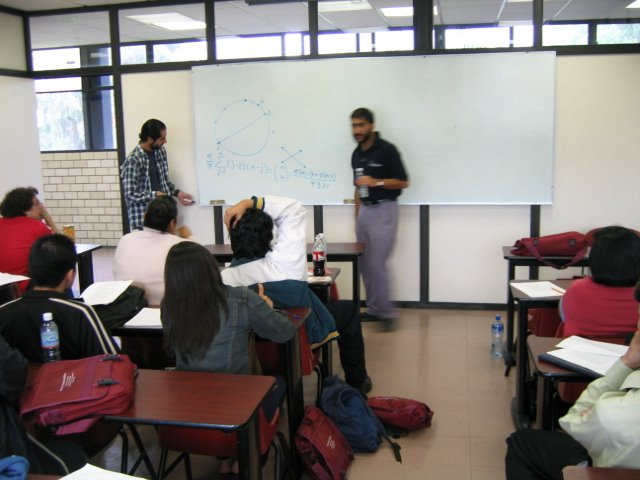
These open days at the University (of Tamaulipas) Saturday's workshop entitled "Science Workshop for young people." Responded to the call two high school teachers with 7 of its students, and a retired teacher.

The writer was in charge of the session with the intention to start developing the theme of "complex numbers and Euclidean geometry, a topic that I find very productive for solving geometric problems from an algebraic point of view.

The age of the participants (12 to 15) made me wonder, and better I ask you bring a problem of geometry that would like to address here with me? And his answer made me suspend the issue of complex and enter the matching of triangles, a common theme but has more potential than you might think to solve problems. Boys took out his notebook and I raised the

Problem 1:

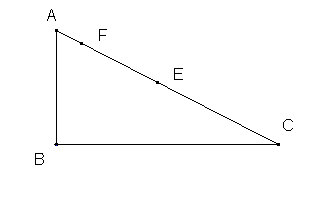
In triangle ABC, with right angle at B, E and F are AC so that AB and AE = CF = CB. How long is the angle EBF?

Solution:

I decided to accept the challenge of solving (help) this problem is elementary geometry, however, their fine detail. I started with a discussion about drawing the figure and evoke theoretical meaning from the data.


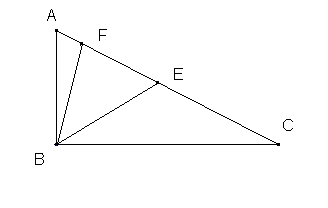
The condition of equal segments seems to suggest using congruence of triangles. But once you see a figure closer (about especially after drawing BF and BE) the hypothesis of congruence should be replaced by isosceles triangles.


It is therefore clear that the triangles ABE and BCF are isosceles. And once you are bringing to mind the concept of an isosceles triangle, with it comes the "base angles equal."

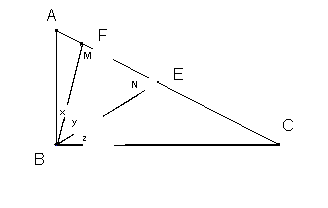
So far, the cognizable is the expectation that the idea of \u200b\u200bequal angles at the base will be of some use. And yes. Because it allows the implementation of the algebraic machinery: M = x + y, N = y + z ... And an elementary teoremita was not mentioned (the sum of angles of a triangle is 180 ...) comes to save the whole situation: M + N + y = 180.


Since, moreover, by data we know that x + y + z = 90 ... a bit of algebra leads us to the answer y = 45.

us comment, finally, it is extremely rewarding experience for a math teacher to have a teen audience interested. It is indeed an extraordinary experience because it is common to have a captive audience (and the worst is that the teacher is also captive) with all the implications it may have the adjective. And one of them is the indifference of the majority.

While it is true that everyday classroom tend to negotiations for peaceful coexistence teacher-student, it is also true that most of the time these covenants courtiers are not entirely satisfactory to the parties - at least for the teacher who is trying to satisfy two conflicting forces: the duty to be of quality education in response to a society that naively still waiting for the educational system and the educational reality has used students to make paper without any effort on your part. Neither good nor bad, it's just a fact of life in Mexico. (Does the fact that the OECD we stand at last in the long run might change the situation?)

JMD in VL greets ... and promises to post more often ... at least one problem was solved in the Saturday session of the workshop ...

Monday, January 16, 2006

Profession Hair Color Sold On Line

mathematics education reform and lifestyles

loci: Who cares?


Opening

well known is the locus of a point moving always remaining the same distance from two separate fixed points A and B. That is, the point X moves in the plane such that AX = XB or, equivalently, AX-XB = 0. Well, I mean ... well known for one who has ever seen and used many times. This is the bisector of the segment AB, ie perpendicular to AB at its midpoint.


Development
The analytical form of view this result is placed in the Cartesian coordinates of points A and B in the simplest way possible: A = (a, 0) and B = (b, 0). So if X = (x, y), we apply the distance formula between two points for

(xa) ^ 2 + y ^ 2 = (xb) ^ 2 + y ^ 2, where we get


xa = xb or xa =- x + b.

From the first equation gives a = b there is no segment AB because both points coincide (and nothing can be concluded.)

From the second you get x = (a + b) / 2. And this is the result we want.

But this requires analytical result a "translation." First you have to "read" him that if the abscissa (x-point moves) remains constant, then the point X describes a line perpendicular to the axis x (moving parallel to the axis and then
always stays the same distance ( a + b) / 2 of it). Second must be "read" that (a + b) / 2 is the midpoint between A and B. Close


But, right now! this speech is raised from the standpoint of the teacher. Let's look now from the standpoint of the boy of 16 who is taking his first course in analytic geometry. What do you know and what does not? Assuming

understand natural language English, are in any way some terms you may not know:

locus "?
Distance?
fucking "fixed?
"bisector?
"coordinates?
point "mean?
"analytically?
"Cartesian plane?
"abscissa?

Professor reflect on these possible unknowns can be paralyzed and conclude that mathematics education is impossible. Also because the current educational reform could be demanding not only learn these concepts
but learns them significantly.

But "significantly" is an adjective with a thousand interpretations ...
and the parent seems to be 1) team building, 2) engage in any activity that creates appropriate, 3) discussion and 4) conclusion ...

And the key to this interpretation of "activity", so that the learning of relevant content (in terms of discipline) has been replaced in practice by implementation of significant activities for students (item of view of experts in education). Neither good nor bad just a trend of contemporary education. Opening 2


But look at this other locus. Details: segment AB constant k, the point X moves so that ^ 2-XB AX ^ 2 = k.

Riddle: What describes locus X?


Development 2 Solution: (for extreme cases)

If k = AB ^ 2 then AX = XB ^ 2 ^ 2 + AB ^ 2 and is (recalling the Pythagorean theorem) that the locus is a perpendicular to AB and B.

If AB =- k ^ 2 then AX ^ 2 + AB ^ 2 = XB ^ 2 and is (again by Pythagoras) the locus is a perpendicular to segment AB but now by A.

If k = 0 then there is the bisector as locus described by the point X.

Of these three extreme cases can develop the assumption that the locus is a perpendicular searched the segment AB. And then there's another idea: k depends on the cross (and the crossing depends on k) of the intersection of the perpendicular to the segment (with the line, rather) AB. (Assume that crosses X ', then k = AX' ^ 2-XB '^ 2.)

is left as an exercise for the reader the analytical demonstration with X = (x, y), A = (a, 0) , B = (b, 0) and k either, where you should get - after doing some algebra - 2 (ab) x = a ^ 2-b ^ 2 + k. As an exercise also aims to "read" here
the geometric interpretation in two parts as in the case of the perpendicular: how do we know that the locus is perpendicular to segment AB? How know where it intersects the line AB? Close

2

I would like to stress here, as a closing comment, that the activity of problem solving school mathematics there are three well-defined moments: a formulation (analytical or synthetic) of the problem - using data to define a solution plan - a plan monitoring, and interpretation of results should answer the question posed in the title.

And to the question of education expert "what applies to this?", Would respond with "is a workout." And if the experts say: A training and what for Why? Well, this is a cognitive skills training, to
while the trainee is being trained to show you the potential of symbolic reasoning in mathematics.

And if you insist: And all this will serve you in your adult life? Well, it all depends on your lifestyle and what specific practices are given in it ... You do what you have been served not have developed those skills? JMD in VL


greets (and have presented them this picture when he went to eat squash blossom quesadillas to the Faculty of Sciences UNAM - October 2005)

Thursday, January 12, 2006

Feeling Weak Headache

Effect flashback in mathematics education

Effect flashback in mathematics education

For some reason (documented in the literature of cognitive psychology by Daniel Kahneman), many educators believe that the solution of a mathematical problem (school mathematics) can be discovered by any trainee. But it is easy to see that even the teacher can be difficult to discover (or rediscover). These days

was designing a training module on the use of complex numbers to solve geometric problems. At one point she needed to justify (prove) that multiplication by the complex z = r (cost + Isent) executes two actions on another complex z '(z times): the longer times and tour r t degrees.

And needed proof of this result, in turn, the formulas of sine and cosine of the angle sum. A widely used formulas without anyone wondering why they are valid. Are some formulas in some way and "natural" is nauralizado use in solving problems. But considering that the audience targeted by the training module that concerns me is that of teens interested in math contest, then I myself felt the need to demonstrate these formulas. (Here comes the personal opinion, it is difficult to decide in a situation Teaching what to say and what to keep ... but ...)

And I said, "cakewalk." This should be easy ... But no. The key idea of \u200b\u200bthe show did not come, although he was convinced that it should be easy. So I had to resort to a book. Found appropriate by the Dolciani (Modern Introductory Analysis), a very good school math book despite being seventies (I mean the time of axiomatic fashion.)

I had seen and proved the theorem once, so to see the Dolciani experienced a rediscovery and I felt a little embarrassed with myself. Because the key idea is extremely simple! (It is the classic, "expresses the amount of two different modes, retainers and clear") And yes, it is difficult not to conclude - in these cases - that "anyone can come up with."

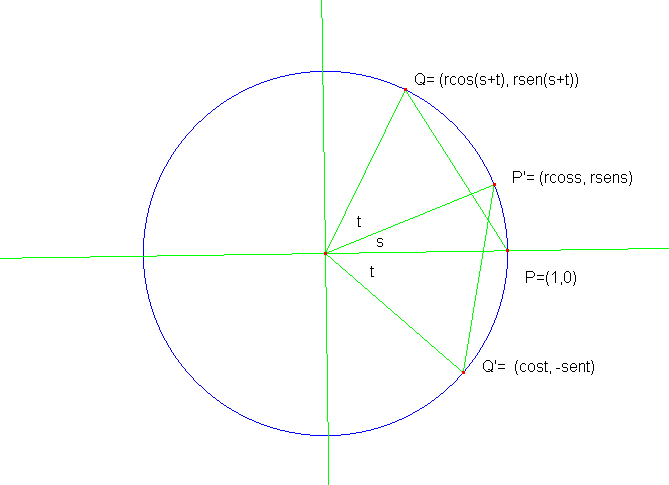
The reader may consider the following figure as a test "almost speechless" in the formula of the cosine of the angle sum. Just "see" that PQ = P'Q ', applying the formula of distance between two points and clear.


But I wish to emphasize here is that this feeling of "anyone can come up with is a kind of reverse conclusion:" Now I saw the solution seems trivial, so it was always trivial ".

Let me conclude these reflections with a moral teaching. What seems to be the case, trying to escape the "optical illusions" retrospective effect is that an idea, however simple it may seem in retrospect, may be inaccessible to the learner's cognition without the help of a suggestion from the instructor. But you can also say that such ideas are exemplary and should remain accessible in the memory of cognizable interest in the math contest. How? Well, that would be a topic for another post, but it might help to start with an inventory of key ideas for solving problems of competition - the way a chess player tirelessly studying openings, finishes, and middle game tactics. JMD in VL

wish you a happy (or not so unhappy lost) 2006

Thursday, November 17, 2005

Heather Brooke Friends Name

creativity Beyond: Menelaos in Monterrey (1997)

National Contest Problem 2 (Monterrey 1997)

There are times when creativity is not enough (what is creativity? ), at least not creativity, in a populist version of the term, calling for the neglect of any theory for the sake of a sort of mystic illumination in the performance of intellectual tasks. I will argue for the proposition that expert knowledge cognizable maximizes efficiency in problem-solving tasks (or at least never is over) on the pretext of the next issue of the national competitive Mexican Mathematics Olympiad. Statement


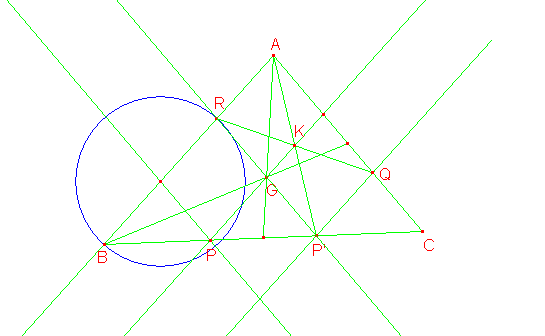
In a triangle ABC, P and P 'are two points on the side BC, CA Q & A on AB, so that AR / RB = BP / PC = CQ / QA = CP' / P'B. Let G be the centroid of the triangle ABC and K the intersection of AP 'with RQ. Show that P, G and K are collinear. Background Information

(a solution)

In the national contest of WMO (Mexican Mathematics Olympiad) in 1997 for the first time I knew that there was a theorem of Euclidean Geometry called Menelaus Theorem. As is known, the geometry in the school yard occupies a very marginal with a very marked bias in favor of algebra and analytical methods. And this seems to be the case throughout the world for some time now (perhaps since the advent of set theory in the early 1960).

In 1967, an American book that I got later to the intellectual shock of Monterrey (Coxeter and Greitzer, Geometry Revisited), the authors complained in the preface to the marginality of the geometry: "Perhaps the inferior status of geometry in the school curriculum comes from a lack of familiarity on the part of educators with the nature of the geometry and the advances that have taken place in its development. "

Anyway, Tamaulipas team of 6 teenagers with aspirations to enter the mathematical community came to Monterrey in the year of 97 with a background of knowledge completely out of context (which includes your coach, ie, me). An anonymous joke generated during the days after the contest read: "the Tamaulipas believe that all triangles are equilateral." (politically incorrect jokes are the most hurt, but possibly are the most commonly learn - neither good nor bad it's just that we were the Tamaulipas and the national competition that year, 1997.)

Valentina (17) was the one who told me, leaving examination of the first day and with a sad face and wonder: "2 out with Menelaus." But not because she had been resolved but because I heard in the corridors of mouth of fellow contestants that they had resolved itself. I lighten up something because at the meeting for discussion of issues that day so as to establish evaluation criteria, where delegates and advisers from all states first try to resolve the problems, none of the state advisory was even draw the figure describing the statement. Shame and disappointing surprise! And I thought that Val had received a good workout! Construction

in Figure guide

In diagrammatic reasoning (now I know) the diagram or image that guides the reasoning has to be generally free of irrelevant details and / or distracting the goal of reasoning. But in this case, to draw the figure describing the statement, the reasons given as data in the statement must have a particular k value, or the figure is impossible to draw.

Keep it Simple (KISS principle of design), warns the hacker slogan. So here I choose to keep the figure (e) Simple Stupides taking k = 1 / 2, ie the sides and Place trisecting points.


Digressions hints and clues about settlement

1) If verbalize the equal status of reasons it may be said that P, Q, R are based on the sides at the same rate, but also P 'part CB (BC reverse) in the same proportion as P part BC. This kind of symmetry is difficult to see at first glance (even to the trained eye). To the trained eye (in geometric problems Olympiad) likely this symmetry first acquires salience (something she suggests it is valuable scrutinize more closely) and only later is focused (looking implications derived
help the solution of the problem), and it if necessary to cover some details of the settlement plan.

However, after taking the picture, the cognized could be questioned whether the midpoint M of side BC is seen as the midpoint of PP 'only by the figure or is derivable from the condition. In my case, now that I address the problem years after that contest Monterrey, I explored this question at the end of the test as a need to come to a conclusion: that wanting to M was the midpoint of PP 'can prove to condition from the BP / PC = CP / P'B.

2) The application to demonstrate use Menelaus immediately suggests collinearity. But I suggest to anyone who knows the theorem and has experience with its instances of use. In 1997 I stayed just amazed that Valentina and I could do more partnerships that will link the data with geometric knowledge necessary for solving the problem (what to say to the solution ... I would have been happy if he had drawn the figure!) .

But suppose the cognized Menelaus can evoke from the statement. In that case, the following two tasks that immediately arise are a) finding the right triangle b) proceed to prove that the product of reason in the theorem of Menelaus is unity. (Note, incidentally, that the activation of the network of knowledge associated with Menelaus
- almost as if we had "zipped" in our mind - to cognizable provides an immediate action plan, your mind goes to work instead of keeping wandering in search of a useful idea - one that is wandering in the long sickening, especially when no useful idea comes.

3) Another clue to the solution that is included in the statement are the ratios RA / RB = CP '/ P'B (which almost immediately leads to the conclusion RP' parallel to AC) and QC / QA = CP ' / P'B (and seen to P'C is parallel to AB). These two ratios lead to the conclusion that the quadrilateral is parallelogram ARP'Q.

From here, cognizable eventually come to see that K is the intersection of diagonals which it could lead to another demonstration (No Menelaus) based on the idea that a medium must pass through the barycenter (centroid) - to which can be reached by a relatively random chain of associations, it also has to see that G is centroid of the triangle APP ' .

With random I mean that the action plan comes after the search for useful ideas (and there is a risk of failing to make them work even when they had sight) and not before as would be natural. With the evocation of the theorem of Menelaus, however, the plan is immediately and it will guide the action: it is like saying "What toolbox use for alignment problems?" - And the answer is and in the question itself ... if you had experience in instances of use of the theorem of Menelaus.

Solution (Menelaus)

Choosing the right triangle for the implementation of Menelaus is almost immediate: AMP is the triangle. " The next task is to show that (AG / GM) (MP / PP ') (P'K / KA) = 1. But this task is reduced to prove that MP / PP '= 1 / 2 for AG / GM = 2 / 1 for the attribute of the centroid location of the median and P'K / KA = 1 because the point K intersection of the diagonals of a parallelogram (the diagonals of a parallelogram bisect).

Here's where the need to demonstrate M is the midpoint of PP '(and not just BC). This can be proved by algebra. If k is the ratio BP / PC then from KPC and BP = CP '= kP'B can come to see that (k +1) PC = (k +1) P'B and therefore PC = P'B. Hence, PP '+ P'C = PP' + PB, ie P'C = PB. So BP + MP = MP '+ P'C and sees that PM = MP'.

Solution (without Menelaus)

Once knowing that M is the midpoint of PP 'show "atheoretical" (ie, elementary geometry) comes to mind from the image of the parallelogram ARPQ. Well, since G is also the centroid of the triangle APP '(the proportion MG / GA = 1 / 2 does not have to change), and since the diagonals of a parallelogram bisect each other, then the triangle median PK APP 'and must pass through G, ie, P, Q, K are collinear. Concluding Remarks


can be seen here (in the way the elementary solution arises or is suggested by the implementation of the solution requires more theory) that the solution "creative" is the least natural. This is because a plan to begin by saying "I will show that PK is average ..." is a plan unlikely. And also because the discovery that M is the midpoint of PP '(present in both shows) was a necessity in the plan Menelaus, and thus guided
by a goal, the ingredient that gives it natural.

Furthermore Menelaus cognizable maximizes efficiency by allowing complete the solution in less than an hour (I think). The moral I can draw from this problem is that the populism of many delegates and / or well-intentioned state coaches who argue that basic solutions Olympiad problems are always possible (as they are), hence to derive the conclusion (wrongly in my apparently) that adolescents who carry competitions require only natural creativity and basic skills, has the perverse effect of causing exactly what you want to avoid: the frustration of the boys.

In trying to avoid stress resulting from learning to demonstrate and use basic theorems and solve complex problems of competition only frustration Translates a week of competition, because there the children discover the futility of their tools in front of the complex tasks problems required a national contest for math Olympiad. [Although it could happen, as in my case the pageant of 97 coaches and delegates are innocent of populism, and simply be because, as Coxeter and Greitzer said, not familiar with the geometry (and other mathematical topics of competition).]