Tuesday, March 21, 2006

British Red Poppy Pin Mean

, Zona Centro, Congruence of Triangles


Problem 1 - the Regional Centre Zone Tamaulipas-


jmd 03/21/2006


Pre-selective examination on Saturday, 18 March at the CBTIS 236 has some lessons for the 16 shortlisted candidates to integrate the selection state of the Mexican Mathematics Olympiad. Above all, training suggestions. Then I will comment on the suggestions of training that we left the problem of geometry.


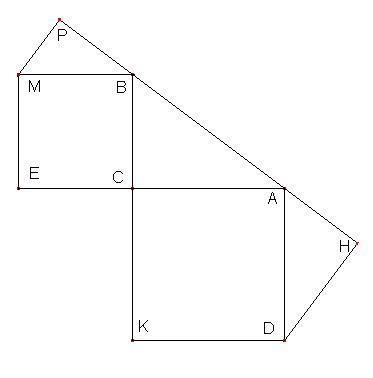
The problem in the legs AC and BC of triangle ABC have been built (outside the triangle) and BMEC ADKC squares. Points D and M are lowered perpendicular DH and MP on (sic) the continuation of the hypotenuse AB. Show that AB = DH + MP.
Elemental

but not both. How to link MP and DH with AB? The problem certainly requires scouting.

The first association is Pythagoras, but after a little pondering is that PB and HA could not be removed from the resulting chain of equalities. In any case, not only Pythagoras.

similarity is another possibility. To the trained eye it is easy to see (or at least suspect) that the three triangles are similar.

Solution:

Denoting a, b, c to the sides opposite the vertices A, B, C, respectively, we can use the previous plan to use Pythagoras (A ^ 2 + b ^ 2 = c ^ 2) and replace b by similar triangles. Clearly the triangles

BMP and DHA are both similar to ABC (the angles CAB and MBP are the same as being relevant, and the same is true of CBA and HAD). Hence

DH / b = b / c MP / a = a / c. That is, a ^ 2 = b ^ 2 = CMP HRC, and substituting in Pythagoras gives the result: c (MP + DH) = c ^ 2 and you're done.

Comments to the solution (from the perspective of the learner)

This problem no contestant solved it. But why is it so difficult? Try seeing it for the parties to respond.

1. Before you even have a chance to resolve the learner should be able to figure (not included in the review). Most of the contestants drawn, so the difficulty is not there. It should, however, included in the training exercises nontrivial geometric trace. (For example, draw a triangle with a ruler and compass given an angle, the opposite side and adjacent one side.)

2. The evocation of Pythagoras is not problem-in fact the first thing that occurred to the majority.

3. The difficulty seems to lie in the recognition of similarity of triangles and the development of the settlement plan that combines Pythagoras and likeness. This points to an intensive training in similar triangles with many exercises, but also training in strategies for solving geometric problems in a "reading between the lines" of data and the figure, an interpretation that allowed the development of a settlement plan.

4. Note on training perspective of the writer:

1) Training is training, and therefore to adopt a position of letting the learner alone with their own creativity is to adopt a populist perspective (but also a contradiction. .. that is the point of training?)

2) Unfortunately, this perspective is present even among mere leaders of the WMO-an example: Illanes said in his book Problems of Olympiad included in the 2 nd edition a new chapter of induction "almost against my will as I have always thought that what should be assessed ... is the ability of students to solve problems and ingenuity put into solving them "-

3) The theoretical results are always useful as equip the learner with a tool box ready to use when drawing up the plan solution, and do not take away creativity and ingenuity but rather the stronger. Workaround


This solution is subtle, it requires training to see the movement of figures through the eyes of the mind.

A dynamic geometry training (with CABRI, for example), would provide the apprentice with a wider menu of creative ideas when preparing a solution plan. Might guess, for example, that the triangles at the ends may be rotated and ...

BMO Turning the triangle on the center B, 90 degrees is obtained BCP triangle. " Turning -90 DHA on A gives the ACH. "


And the settlement plan is almost ... (You're seeing the result, still need to prove it.)


If we call C 'at the foot of the perpendicular to AB lowered from C, the plan would be to demonstrate congruence between pairs of triangles BMP and CBC', ADH and CAC. "

cognitive power acquired by the apprentice training in geometric transformations is enormous. And this is particularly true in the development of the settlement plan. (Note, incidentally, to begin an official solution "is C 'the foot of the perpendicular ..." In other words, lies precisely what the learner needs the most: the methods of reasoning that lead to the development of the settlement plan.)

JMD in VL
greets

Tuesday, February 21, 2006

How To Make Homemade Ramen Soup

Screening

On the notion of congruence of triangles

Equality and consistency

The concept of congruence is related to the equal and it is expected that the learner knows it, either intuitive meaning from natural language or through use in arithmetic. It is customary to speak of congruence geometry rather than equality. For example, two segments are congruent if and only if they have the same measure, and the same is true for angles. But in the case of two triangles, the definition is more complicated because there is no measure (number) that defines a triangle.

triangle as a configuration of points and lines

As we know, there are different classifications of triangles that account for their diversity of form: according to the measure of their angles can be obtuse, rectangles, acutangula, in accordance the relationship of the measures of its sides can be equilateral, isosceles, scalene. That's why a pre-defined notion of congruence of triangles is the correspondence. This is because a triangle (and any polygon) is a configuration consisting of points and line segments (sides) that connect pairs of points.

Congruence triangles as intuitive notion and its formalization

Having discovered that two triangles are congruent (equal) should put their corresponding vertices. To say that the triangle ABC is in correspondence with IJK means that the correspondence between its vertices is AI, BJ and CK. And in this correspondence is implicit in the correspondence between the sides: AB-IJ, JK and BC-CA-KI. But it is also implicit correspondence between the angles: the angle at A is congruent to angle R, etc. (Note: not all texts follow this convention, that is, even when claiming "ABC is in correspondence with IJK "do not respect the above rules of implied correlation-a shame ... but what are you going to do.)

And when I say" discovered "I mean the view consistency cognizable by intuitive and informal methods, or perhaps rather, "sees." But once you "see" the consistency should be formalized. This is desirable because once the correspondence and consistency in the way explained above, it is not necessary to see the figure to raise equations or reasons, then the correspondence between vertices and sides are implicit in the correspondence between the triangles as already explained.

To see the need to search for consistency, that is, something (a sentence, a fact, ...) in the problem statement to suggest that consistency can be used for its solution. And to find it, once you seek it is convenient to use the intuitive definition: two triangles are congruent if they can be matched one on the other by rotations, translations and / or reflections. (The formal definition is: two triangles are congruent if, in the correspondence between their vertices, are equal to the corresponding sides and corresponding angles.) In a triangle congruence then have six pars, three sides and three angles. It is therefore very useful have criteria that tell us whether two triangles are congruent without having to verify the six equalities.

matching criteria as postulates

The criterion (principle) of consistency is perhaps the most basic criterion called LAL (side-angle-side) tells us that if, in a letter of triangles, two sides of one and the angle between them are equal to their corresponding elements in the other, then the two triangles are congruent. Some texts of formal geometry, the most in the logical sense, taking this approach as an axiom and show the remaining two, the ALA and the LLL. Other texts-most- postulated as true the three criteria. It is recommended then that the learner's take the three as postulates for if in any way is going to take a postulate ...


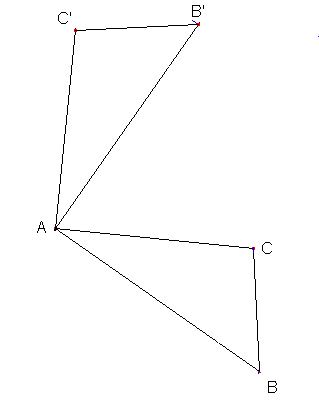
In the figure, the triangles ABC and AB'C 'are in correspondence. The second is the result of the first rotated 90 degrees. If the missing segment BC, however the distance between A and B would remain after the turn.

Instance of use (classical) of the LAL test

isosceles triangle theorem:

If a triangle is isosceles then its base angles are equal. (Note: it is customary to understand the basis, the third side, the first two are the ones who know the same.)

Demo:

Warning: This instance of use is somewhat disconcerting when you first see it, so it asks reader's cognitive cooperation. (The confusion is perhaps due to the triangle is placed in correspondence with himself, which is not forbidden but because one thinks that this ban was implicit in the definition of consistency.)


The isosceles is sample can be called triangle ABC. But, crossing the vertices in the opposite direction can be called triangle BAC. Correspondence is valid for ABC-BAC.

Since the triangle is isosceles with CA = CB and BC = AC. Also, since it's the same triangle, the angle at C is identical to itself. There is therefore a correspondence LAL and the two triangles are congruent. But then the other elements put in correspondence are also equal. In particular the angle at A is equal to angle B.

second instance of use (also classic) the LAL test

In an isosceles triangle, the bisector of the vertex opposite the base divides the triangle into two congruent.

Demo:

In the above figure draw the bisector of angle C and assume that intersects the side AB at M. By hypothesis and MCB ACM angles are equal. This suggests the CC correspondence. On the other hand, by definition, AC = CB. This correspondence suggests AB, and the other point common to the triangles formed by the bisector is M, which suggests the MM correspondence.

Thus, we test the correspondence ACM-BCM. We have, AC = BC and CM = CM, to be seen whether the angle formed by AC and BC is equal to BC and consisting of CM. But that is true because CM bisector. So we can use the LAL test to establish that the positions corresponding triangles are congruent. This congruence

well established are still several

Corollaries (for isosceles):

a) The bisector is also bisector (as AMC and BMC angles are equal and their sum is a plain, but also the corresponding sides AM and BM are equal, so that MC is perpendicular to the midpoint of the base)

b) The bisector is also medium (for AM = BM)

c) The bisector is also high (as AMC and angles BMC are straight) Final comments


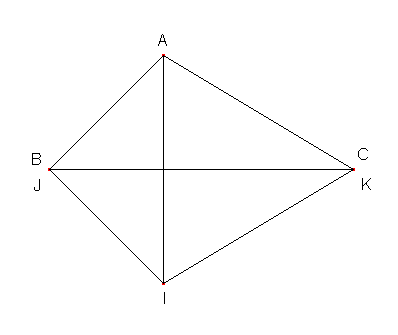
can deduct the standard LAL LLL from applying the properties of an isosceles triangle, the triangles LAL is placed in correspondence as shown in the figure and ...


Since AB and AB = IJ = IK, we have the isosceles ABI and ACI. But then its base angles are equal. Adding, we find that the angles at A and R are equal and we are now able to apply the LAL test to ensure that the triangles ABC and IJK are congruent.

Say, finally, that the notion of congruence of triangles is very close to the foundations of Euclidean geometry. But the apprentice does not need to justify everything, especially near the foundation theorems. It is better, from the point of view of solving problems, to take the matching criteria as axioms and shamelessly use in solving problems. This allows you to move forward in its appropriation of theoretical tools without wasting time on formalities. Also be taken as equal angles formed by two parallel and a transversal. Of course it is desirable that some may see demonstrations of the basic theorems, but that can wait ... Meanwhile, to solve problems ... in VL
JMD
greets

Sunday, February 19, 2006

What Does A Brazilian Shave Look Like

An elementary geometric problem

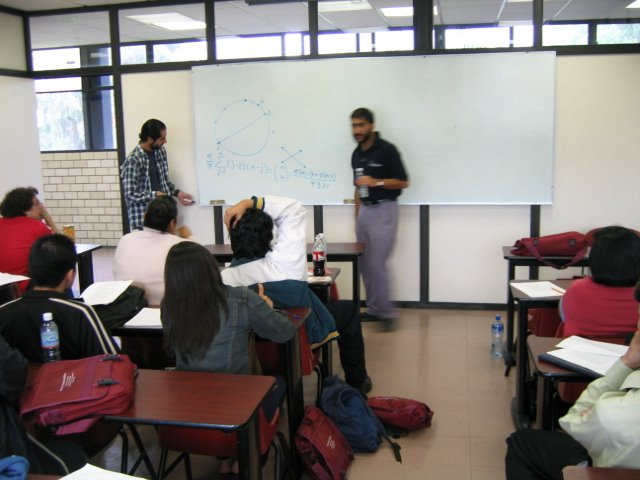
These open days at the University (of Tamaulipas) Saturday's workshop entitled "Science Workshop for young people." Responded to the call two high school teachers with 7 of its students, and a retired teacher.

The writer was in charge of the session with the intention to start developing the theme of "complex numbers and Euclidean geometry, a topic that I find very productive for solving geometric problems from an algebraic point of view.

The age of the participants (12 to 15) made me wonder, and better I ask you bring a problem of geometry that would like to address here with me? And his answer made me suspend the issue of complex and enter the matching of triangles, a common theme but has more potential than you might think to solve problems. Boys took out his notebook and I raised the

Problem 1:

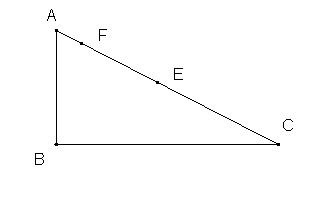
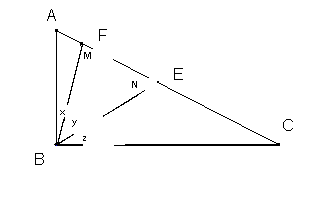
In triangle ABC, with right angle at B, E and F are AC so that AB and AE = CF = CB. How long is the angle EBF?

Solution:

I decided to accept the challenge of solving (help) this problem is elementary geometry, however, their fine detail. I started with a discussion about drawing the figure and evoke theoretical meaning from the data.


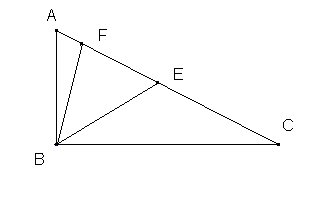
The condition of equal segments seems to suggest using congruence of triangles. But once you see a figure closer (about especially after drawing BF and BE) the hypothesis of congruence should be replaced by isosceles triangles.


It is therefore clear that the triangles ABE and BCF are isosceles. And once you are bringing to mind the concept of an isosceles triangle, with it comes the "base angles equal."

So far, the cognizable is the expectation that the idea of \u200b\u200bequal angles at the base will be of some use. And yes. Because it allows the implementation of the algebraic machinery: M = x + y, N = y + z ... And an elementary teoremita was not mentioned (the sum of angles of a triangle is 180 ...) comes to save the whole situation: M + N + y = 180.


Since, moreover, by data we know that x + y + z = 90 ... a bit of algebra leads us to the answer y = 45.

us comment, finally, it is extremely rewarding experience for a math teacher to have a teen audience interested. It is indeed an extraordinary experience because it is common to have a captive audience (and the worst is that the teacher is also captive) with all the implications it may have the adjective. And one of them is the indifference of the majority.

While it is true that everyday classroom tend to negotiations for peaceful coexistence teacher-student, it is also true that most of the time these covenants courtiers are not entirely satisfactory to the parties - at least for the teacher who is trying to satisfy two conflicting forces: the duty to be of quality education in response to a society that naively still waiting for the educational system and the educational reality has used students to make paper without any effort on your part. Neither good nor bad, it's just a fact of life in Mexico. (Does the fact that the OECD we stand at last in the long run might change the situation?)

JMD in VL greets ... and promises to post more often ... at least one problem was solved in the Saturday session of the workshop ...

Monday, January 16, 2006

Profession Hair Color Sold On Line

mathematics education reform and lifestyles

loci: Who cares?


Opening

well known is the locus of a point moving always remaining the same distance from two separate fixed points A and B. That is, the point X moves in the plane such that AX = XB or, equivalently, AX-XB = 0. Well, I mean ... well known for one who has ever seen and used many times. This is the bisector of the segment AB, ie perpendicular to AB at its midpoint.


Development
The analytical form of view this result is placed in the Cartesian coordinates of points A and B in the simplest way possible: A = (a, 0) and B = (b, 0). So if X = (x, y), we apply the distance formula between two points for

(xa) ^ 2 + y ^ 2 = (xb) ^ 2 + y ^ 2, where we get


xa = xb or xa =- x + b.

From the first equation gives a = b there is no segment AB because both points coincide (and nothing can be concluded.)

From the second you get x = (a + b) / 2. And this is the result we want.

But this requires analytical result a "translation." First you have to "read" him that if the abscissa (x-point moves) remains constant, then the point X describes a line perpendicular to the axis x (moving parallel to the axis and then
always stays the same distance ( a + b) / 2 of it). Second must be "read" that (a + b) / 2 is the midpoint between A and B. Close


But, right now! this speech is raised from the standpoint of the teacher. Let's look now from the standpoint of the boy of 16 who is taking his first course in analytic geometry. What do you know and what does not? Assuming

understand natural language English, are in any way some terms you may not know:

locus "?
Distance?
fucking "fixed?
"bisector?
"coordinates?
point "mean?
"analytically?
"Cartesian plane?
"abscissa?

Professor reflect on these possible unknowns can be paralyzed and conclude that mathematics education is impossible. Also because the current educational reform could be demanding not only learn these concepts
but learns them significantly.

But "significantly" is an adjective with a thousand interpretations ...
and the parent seems to be 1) team building, 2) engage in any activity that creates appropriate, 3) discussion and 4) conclusion ...

And the key to this interpretation of "activity", so that the learning of relevant content (in terms of discipline) has been replaced in practice by implementation of significant activities for students (item of view of experts in education). Neither good nor bad just a trend of contemporary education. Opening 2


But look at this other locus. Details: segment AB constant k, the point X moves so that ^ 2-XB AX ^ 2 = k.

Riddle: What describes locus X?


Development 2 Solution: (for extreme cases)

If k = AB ^ 2 then AX = XB ^ 2 ^ 2 + AB ^ 2 and is (recalling the Pythagorean theorem) that the locus is a perpendicular to AB and B.

If AB =- k ^ 2 then AX ^ 2 + AB ^ 2 = XB ^ 2 and is (again by Pythagoras) the locus is a perpendicular to segment AB but now by A.

If k = 0 then there is the bisector as locus described by the point X.

Of these three extreme cases can develop the assumption that the locus is a perpendicular searched the segment AB. And then there's another idea: k depends on the cross (and the crossing depends on k) of the intersection of the perpendicular to the segment (with the line, rather) AB. (Assume that crosses X ', then k = AX' ^ 2-XB '^ 2.)

is left as an exercise for the reader the analytical demonstration with X = (x, y), A = (a, 0) , B = (b, 0) and k either, where you should get - after doing some algebra - 2 (ab) x = a ^ 2-b ^ 2 + k. As an exercise also aims to "read" here
the geometric interpretation in two parts as in the case of the perpendicular: how do we know that the locus is perpendicular to segment AB? How know where it intersects the line AB? Close

2

I would like to stress here, as a closing comment, that the activity of problem solving school mathematics there are three well-defined moments: a formulation (analytical or synthetic) of the problem - using data to define a solution plan - a plan monitoring, and interpretation of results should answer the question posed in the title.

And to the question of education expert "what applies to this?", Would respond with "is a workout." And if the experts say: A training and what for Why? Well, this is a cognitive skills training, to
while the trainee is being trained to show you the potential of symbolic reasoning in mathematics.

And if you insist: And all this will serve you in your adult life? Well, it all depends on your lifestyle and what specific practices are given in it ... You do what you have been served not have developed those skills? JMD in VL


greets (and have presented them this picture when he went to eat squash blossom quesadillas to the Faculty of Sciences UNAM - October 2005)